

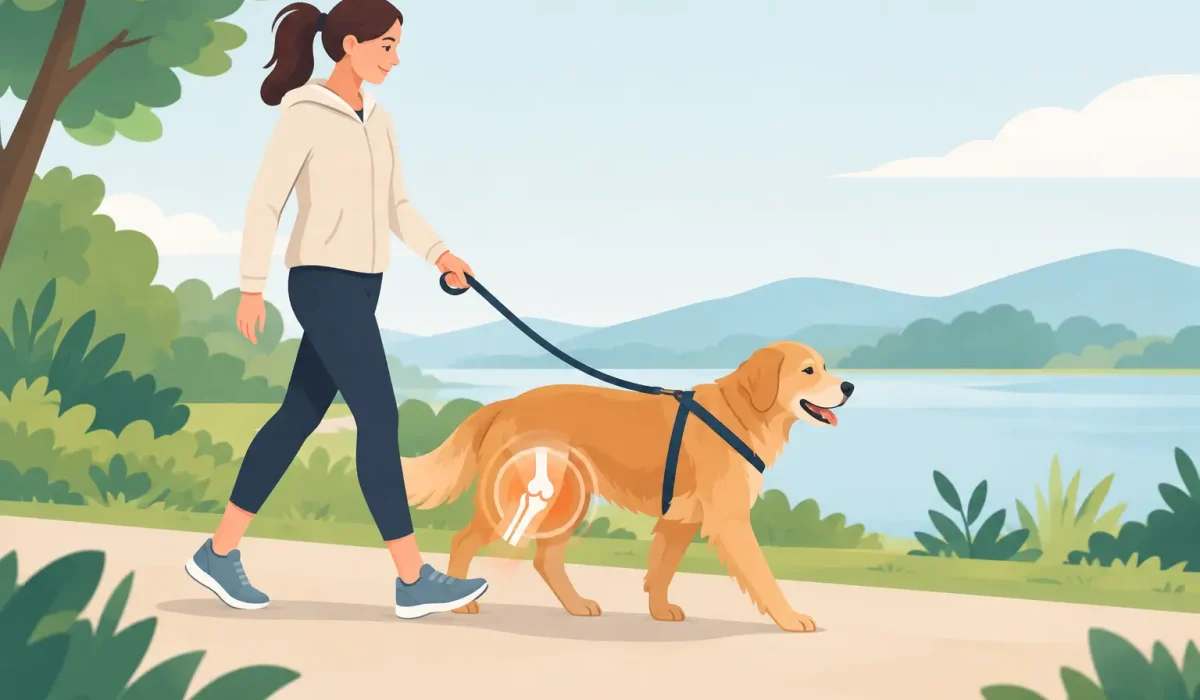
A dog who hesitates in front of the sidewalk, slows down when he returns or goes to bed just after his exit does not necessarily lack envy. Osteoarthritis can make each movement more uncomfortable, especially after rest, in cool weather or on irregular soil. Adapting the walk of an arthrosic dog allows it to maintain its activity without asking for an effort that it can no longer provide serenely.
The walk remains precious: it maintains mobility, stimulates the senses and offers your companion a moment of pleasure out of the house. The aim is not, therefore, generally to remove exits, but to make them shorter, more regular and better suited to their daily condition.
Understanding the needs of a dog with osteoarthritis
The osteoarthritis corresponds progressive wear of the joints. It is common in elderly dogs, but may also affect younger dogs after an old injury, joint fragility or overweight. Its expression varies a lot from one animal to another: some continue to call for long walks, even when they are in pain, while others quickly show their discomfort.
The difficulty is that the dog does not verbalize pain. It can simply walk slower, move when you touch it, climb harder in the car or avoid stairs. An exit that seemed usual can then become excessive without it being obvious at the moment.
The right rhythm depends on his age, his size, his joints concerned, his previous level of activity and the weather. There is no ideal duration for all arthrosic dogs. What matters is its ability to recover comfortably after effort.
Adapting the dog's arthrosic promenade to daily life
Focus on short and frequent outings
A long occasional walk is often less well tolerated than several quiet outings throughout the day. For many dogs, three or four quiet walks are more comfortable than just one long walk. They allow to loosen the joints gently without creating excessive fatigue.
Start by observing what your dog currently supports. If he returns steep, packs more or seems exhausted after twenty minutes, reduce the duration on the next exits. On the other hand, if he goes forward willingly, recovers well and stays relaxed, you can keep that pace. The adjustment must be gradual, over several days, rather than decided after a single walk.
Give him time to sniff, too. For an elderly or painful dog, the quality of the exit is not measured at the distance travelled. Explore smells, choose a peaceful path and walk at its pace bring real mental stimulation, even on a short journey.
Choose a smooth and predictable course
Stable and relatively flexible soils are often more pleasant than pavements, very stony roads or steep slopes. A quiet park, a compact dirt driveway or a regular sidewalk can be better suited than a rough route. However, your dog's habits must be taken into account: too soft or slippery soil can also destabilize it.
Avoid as much as possible repeated climbs and descents, sudden starts and steering changes imposed by a too short leash. On the French Riviera, the heat of the soil in summer deserves special attention. The morning or evening outings are then more comfortable, especially to limit fatigue and the risk of slipping on a very warm surface.
Regularity also reassures the dog. Retracing a known route, with few rough crosses, allows it to move without tension. If your companion becomes anxious about other dogs or bikes, choosing a quieter schedule can make a real difference.
Respect her appearance, even though she has changed
An arthrosic dog should not be pulled to accelerate, nor encouraged to keep pace with another more dynamic animal. Walk next to him, without tension on the leash, and take the breaks. Stopping for a few moments to observe or sniff is not a failure: it is sometimes the way it naturally regulates its effort.
A well-fitted harness can be more comfortable than equipment that exerts traction on the neck, especially when the dog lacks balance or moves with caution. Check that it does not rub under the armpits and does not interfere with the movement of the shoulders. For a dog with difficulty in getting up or walking, suitable support can be discussed with the veterinarian.
Repeated throwing games, sudden sprints and high-speed stair climbs are generally not suitable when the joints are fragile. This does not mean that all joy must disappear from the walk. Prefer a search for sweets in grass, a time of flair or a calm exercise of attention. Your dog thus keeps the pleasure of being outside without brutally asking for his body.
Before and after exit: the details that matter
The first minutes of walking are often the most delicate, especially after a nap or waking up. Start slowly, on flat terrain, without immediately asking for a large distance. Some dogs need a few minutes to find a more flexible step.
When returning, carefully dry the legs and lower belly if the weather is damp. A warm, thick and easily accessible bed allows for a comfortable rest. Limiting jumps from the sofa, the bed or the trunk of the car can also reduce difficult everyday moves. A ramp or intermediate walk can be useful depending on the size of the dog and the layout of your home.
Watch the hours following the walk. A more pronounced discomfort in the evening, a difficulty in getting up the next day or an unusual refusal to leave are valuable information. Note mentally, or in a notebook, the length of the walk, the course and its recovery. These observations will help identify what really suits him.
The signs that should lead to seeking advice
A new lameness, obvious pain, sudden mood change or rapid decrease in mobility warrant veterinary advice. It is the same if your dog groans during manipulations, refuses to lay a leg, falls, hassles at rest or finds no more comfortable position to sleep.
Don't wait until your companion can't walk around to make a point. An examination allows you to assess your mobility, remove other possible causes and build a support consistent with your daily life. The weight, living environment, type of soil and frequency of exits are an integral part of this reflection.
For dogs who are difficult to move or are not able to travel, a home consultation provides a great comfort. In Cannes and nearby municipalities, Dr.Point Elsa can observe your dog in his familiar environment: the way he gets up, goes to bed, walks or joins his basket often gives very useful guidance.
Keep the walk as a moment of pleasure
L’arthrose demande des ajustements, mais elle n’enlève pas le besoin de sortir, de sentir, de regarder et de partager un moment avec vous. Certains jours seront plus faciles que d’autres : le temps, la fatigue et l’évolution de la douleur influencent naturellement ses capacités. Adapter le programme à ce qu’il vous montre est une attention concrète, pas un renoncement.
Une promenade réussie est celle dont votre chien revient apaisé, sans raideur accentuée ni épuisement. En ralentissant avec lui, vous préservez non seulement ses articulations, mais aussi ces petits rituels de confiance qui restent si importants au fil des années.

