

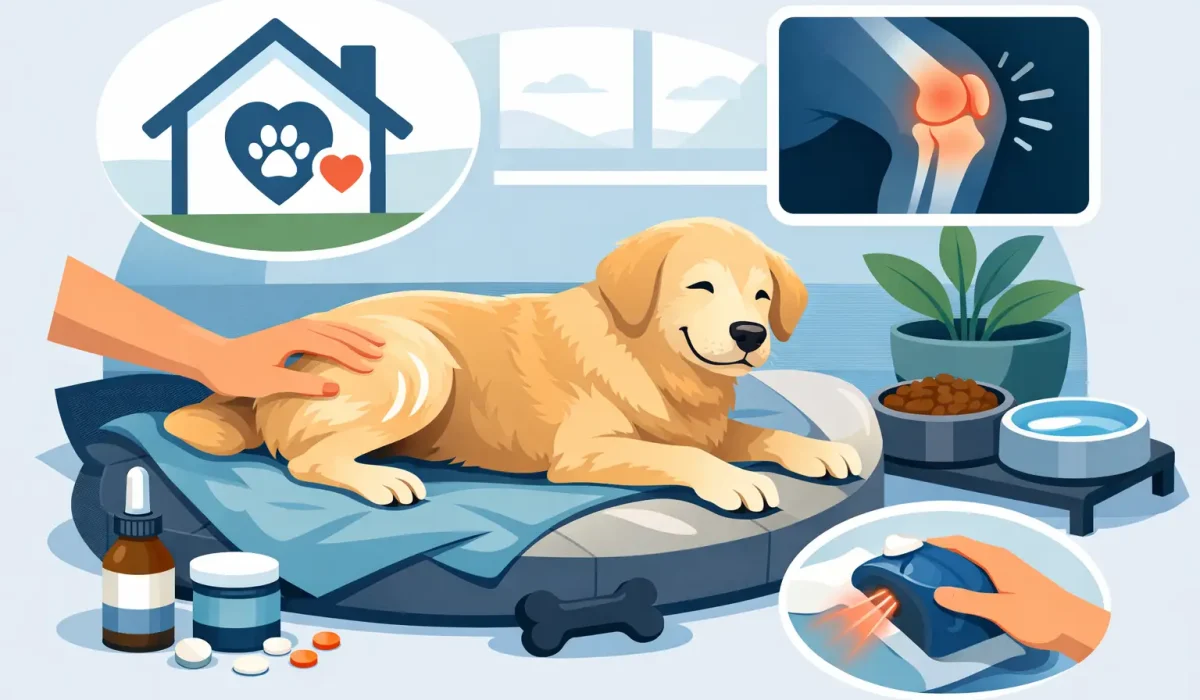
Change is often discreet at first. A dog who hesitates before going on a walk, who goes down more slowly, which seems less suitable for the walk. When these signs settle, the question of osteoarthritis dog home treatment comes back very quickly, with a simple and legitimate expectation: how to relieve it concretely, without imposing more stress on it.
Arthritis is a chronic condition of the joints. It causes discomfort, then pain more or less pronounced, with better days and others more difficult. At home, we do not "heal" osteoarthritis, but we can really improve the comfort of the dog, preserve its mobility and give it a better quality of life. It is often the addition of well thought out small adjustments that makes the difference.
Osteoarthritis dog home treatment: what really helps
The first lever is observation. An arthrosic dog doesn't always limp frankly. It can simply avoid certain movements, change its way of getting up, sleep more or become irritable when manipulated. In elderly dogs, these signs are sometimes attributed to "normal" age, while they actually reflect joint pain that deserves treatment.
At home, the goal is twofold: to reduce stress on the joints and make everyday gestures easier. This involves the environment, the rhythm of life, weight, physical activity and the identification of times when pain takes over. The more regular the accompaniment, the more visible the results are.
It must also be accepted that there is no single universal solution. Some dogs are mostly embarrassed in the morning, others after the exercise or when temperatures fall. Some have pain in the hips, others in the elbows, back or several joints at the same time. A good treatment at home is therefore always adjusted to the dog, his age, his size and his level of autonomy.
Designing the house to limit pain
The ground counts a lot. On tile or slippery parquet, the dog compensates, cries and risks making false movements. Installing non-slip carpets on its usual routes – close to the bed, towards the bowl, in the hallway, in front of the window doors – can already significantly reduce discomfort. It's not spectacular, but it's often very useful.
Sleeping also deserves real attention. A basket too thin or poorly insulated from the ground quickly becomes uncomfortable for painful joints. A thick, stable, easy to access bed, placed in a quiet and temperate place helps the dog to recover better. Many owners also notice that their animal changes less often when its sleeping is better suited.
Stairs, jumps and climbs in the car are sensitive moments. Whenever possible, it is best to limit unnecessary return trips and prefer simpler access. A ramp, intermediate walk or harness help can avoid painful effort. Again, performance is less sought than joint economy.
The height of the bowls may also be reviewed if the dog has difficulty bending, especially when it has cervical stiffeners or pains of the front limbs. This detail is not essential for everyone, but in some dogs it brings real comfort to everyday life.
The right rhythm of activity for an arthrosic dog
Full rest is usually not the right answer. An arthrosic joint needs movement, but a measured, regular and predictable movement. The long irregular weekend walks are often less well tolerated than shorter day trips.
The ideal is to maintain a gentle activity, with walking times adapted to the dog. If your companion seems stiff at the start then more flexible after a few minutes, it is quite typical. On the other hand, if he comes home exhausted, if he struggles to get up after the walk or if he can more the next day, it is that the effort was too great.
The field also plays. Stable and flat soils are often more comfortable than rough trails. Sudden start-ups, games with fast turns or repeated jumps can keep the pain going. It is not a matter of depriving the dog of pleasure, but of offering him an activity compatible with his joints.
In some dogs, a very simple routine is enough: several quiet outings, a gradual warm-up, a return to calm and regularly organized days. The body better supports what it can anticipate.
Weight, a major factor often underestimated
When a dog suffers from osteoarthritis, a few extra pounds can weigh very heavily on its joints. This is one of the most important, and sometimes the most delicate, points to tackle, because an elderly or less mobile dog quickly gains weight. However, a more controlled silhouette often significantly changes walking comfort, ease of rise and endurance.
The difficulty is that a dog that moves less spends less, while eating habits often remain the same. "By affection" treats add up easily. Adjusting quantities, reviewing extras and following the evolution of weight over time are simple but decisive gestures.
Don't look for a quick loss. What counts is a gradual and realistic improvement. Veterinary accompaniment is useful for setting a coherent objective, especially in elderly dogs or with other frailties.
Heat, comfort and soft handling
Many arthrosic dogs are more sensitive to cold and moisture. Keeping a temperate environment, avoiding air currents on the bed and drying the dog well after a wet exit can contribute to its comfort. Some also appreciate a mild heat source, provided it remains moderate and secure.
Manipulation must remain very delicate. Force a limb, stretch "to soften" or want to test a painful joint is especially likely to increase discomfort. On the other hand, calmly helping the dog to get up, support transitions, or organize travel so that he has less effort to provide is often beneficial.
The most useful everyday is often to slow down the overall pace. Allowing the dog to take his time, avoid pressing him, anticipate complicated moments and respect his comfort positions create a more soothing environment. For a painful animal, this safety counts a lot.
When should a veterinary opinion be sought?
Home treatment does not replace a medical assessment. It is particularly important to consult if the discomfort appears brutally, if the dog refuses to lay a leg, if he vocalizes, if he no longer wants to go out, if he falls, or if his behaviour changes markedly. A rapid worsening is not to be trivialised.
Even in an osteoarthritis already known, a new level of pain deserves a veterinary point. Sometimes it's not just "age moving forward." There may be another associated cause, or simply a need to reassess management. In elderly or anxious dogs, home consultation has a particular interest: it allows to observe the dog in its usual environment, without the stress of transport or the waiting room.
À Cannes et dans les communes voisines, ce format est souvent plus confortable pour les chiens qui bougent difficilement, mais aussi pour leurs propriétaires, qui peuvent montrer concrètement les zones glissantes, le couchage, les escaliers ou les habitudes de déplacement. Cela aide à proposer des conseils vraiment adaptés à la maison dans laquelle vit le chien.
Arthrose chien traitement domicile : les erreurs fréquentes
La première erreur consiste à attendre trop longtemps en pensant que “c’est normal à son âge”. Vieillir n’implique pas de vivre avec une douleur non soulagée. La deuxième est de varier fortement l’activité selon les jours, avec un excès d’effort quand le chien semble aller mieux. L’amélioration apparente peut être trompeuse.
Une autre erreur fréquente est de tout changer d’un coup. Mieux vaut commencer par quelques mesures simples et utiles : sécuriser les sols, améliorer le couchage, fractionner les promenades, surveiller le poids et observer les moments où la gêne augmente. Ce sont ces repères qui permettent ensuite d’ajuster la prise en charge avec précision.
Enfin, il ne faut pas sous-estimer l’impact émotionnel de l’arthrose. Un chien douloureux peut devenir plus distant, moins joueur ou moins tolérant, non pas par caractère, mais parce que certains gestes lui coûtent. Quand on comprend cela, on adapte aussi la relation, avec plus de douceur, de patience et d’attention.
Vivre avec un chien arthrosique demande quelques aménagements, mais cela ne veut pas dire renoncer à son bien-être. Souvent, ce sont les détails les plus simples, répétés chaque jour avec constance, qui lui redonnent le plus de confort et de sérénité.

