

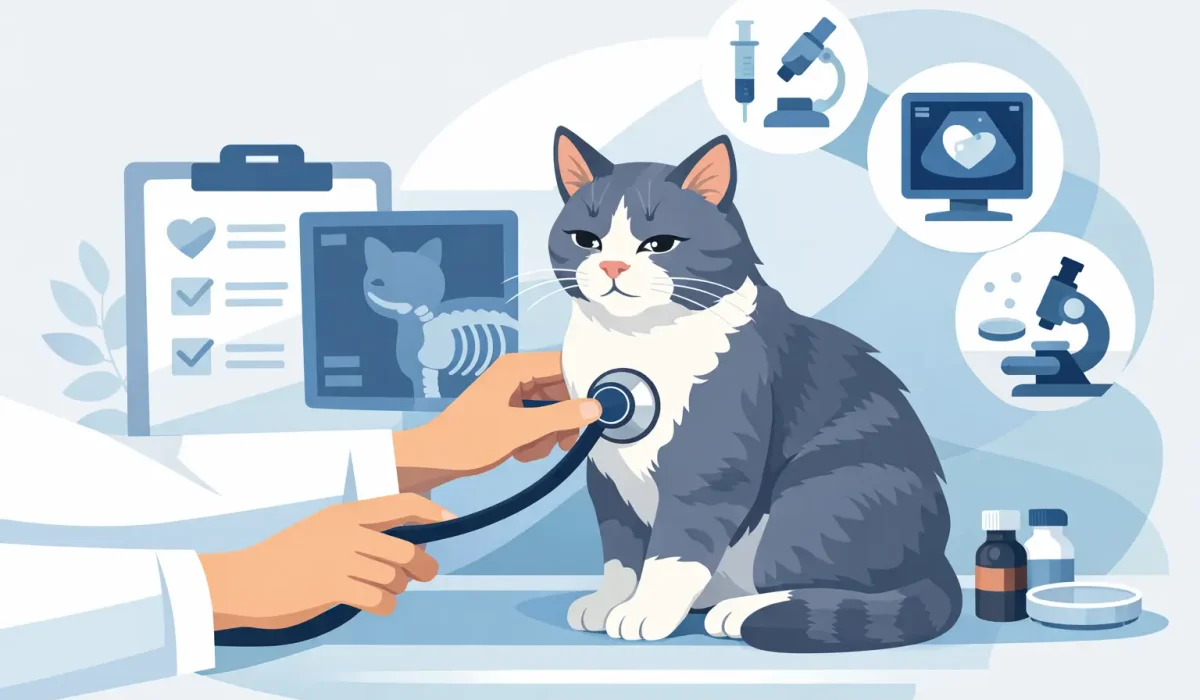
An elderly cat often changes in small keys. He sleeps more, jumps lower, sorts his food, becomes more discreet or, on the contrary, more sticky. Nothing spectacular at first, and that's exactly why a senior cat health check has its place. It allows you to spot what settles in silence, before an discomfort, pain or illness takes too much place in your daily life.
In cats, aging is not similar from one individual to another. Some remain very lively for a long time, others show signs of fragility earlier. The issue is not to wait for an obvious problem, but to follow an evolution. This is often where the veterinary look makes the difference, especially when it can be exercised in a quiet environment, without the stress of transport or the stress of the waiting room.
From what age do we talk about senior cat health check?
A cat is generally considered to enter a senior phase around 10 years, sometimes with increased vigilance from 7 to 8 years depending on its general condition and history. This marker is still useful, but it does not say everything. A cat that has always been anxious, has lost weight recently or has decreased activity sometimes deserves control earlier.
In practice, annual follow-up may be sufficient in a stable, healthy, elderly cat without significant change. But as soon as a doubt arises, or from an advanced age, a closer pace may be preferable. It all depends on what is monitored, the cat's tolerance to manipulations and the presence, or not, of a pathology already known.
Why this is so useful in an elderly cat
The cat has a way of masking discomfort. He continues to eat, to move, to come and greet, and yet something has changed. Joint pain, fatigue due to renal impairment, thyroid disorder or hypertension may develop for a long time without obvious signs for the family.
Health check-up is not just about looking for a disease. It is also used to assess overall comfort. Does the cat drink more than before? Did he lose weight under his hair? Is her coat less maintained? Is his sleep peaceful? Are his movements flexible or hesitant? These are details, but put together, they clearly guide the consultation.
In a senior, early detection often changes the sequence. Not because everything settles easily, but because early care often helps to preserve a good quality of life longer. In many cases, the real benefit is there.
What includes a senior cat health check
A good record starts with listening. Cat habits, appetite, behaviour, weight, mobility and recent changes already give valuable information. Owners often notice important things without knowing that they are. An unusual nocturnal miaulement, a damper litter box, a refusal of heights or a less careful toilet are worth mentioning.
The clinical examination then makes it possible to evaluate the general state. Weight, hydration, mouth condition, coat quality, abdomen, heart, breathing, joints and flexible movement are key points. In the senior cat, this step requires gentle and careful. An animal that quickly cries can show fewer things at the clinic than at home, where it stays in its landmarks.
Depending on the age of the cat, its symptoms or history, additional examinations may be offered. A blood sample is often useful for monitoring such as kidney function, certain metabolic parameters or thyroid. In some cases, urinalysis or blood pressure measurement provides essential information. It is not a question of « all, systematically », but to choose what makes sense to that cat at that time.
The most common diseases identified during the review
In elderly cats, some conditions return more often. Chronic renal failure is one of the most common, with sometimes slow and discreet development. Cats can drink more, lose a bit of state, become more selective on diet or just seem to age. Without a balance sheet, these signs are easily attributed to age.
Hyperthyroidism is another classic cause of change. A cat that eats well but loses weight, becomes more agitated or vocalizes more can show signs of it. Again, only an examination associated with analyses can decide.
The osteoarthritis is also underestimated in cats. Unlike the dog, it rarely packs clearly. He jumps less, takes hijacked paths, hesitates before going up, sleeps more or avoids some access to the house. Many families think their cat slows down « Normal ». Sometimes yes, sometimes no. The role of the balance sheet is precisely to do the part.
Other disorders can also be highlighted, such as high blood pressure, some heart damage, painful dental problems or marked muscle melt. The common point of these situations is simple: the earlier they are identified, the more accompaniment can be adjusted with finesse.
What signs should prompt immediate consultation
Although a routine review is already planned, some changes warrant not to wait. Visible weight loss, decreased appetite, repeated vomiting, increased thirst, more abundant urine, shortness of breath, unusual nocturnal miauments, or marked isolation should attract attention.
It is also necessary to be careful if the cat no longer climbs on the couch, avoids litter, neglects, sleeps hidden or seems less tolerant to the touch. In a senior, these signs are not annoid. They don't always reflect an emergency, but they deserve a real assessment, not just prolonged home surveillance.
Home, a real plus for older cats
For many older cats, getting out of the house is already a test. The transport box, the journey, the unknown smells and waiting are enough to exhaust them. In a fragile, anxious or painful animal, this stress sometimes parasites the examination itself. Heart rate accelerates, breathing changes, the cat freezes or defends itself more.
At home, observation is often more accurate. The cat evolves in its environment, with its landmarks, its hiding places, its habits. You can see better how he moves, where he settles, how he interacts. For families, it is also a more serene setting for asking questions, showing the litter box, the place where it sleeps, or explaining the little things of everyday life that worry without always looking « rather serious » for a classic consultation.
This is particularly relevant for a very elderly cat, suffering from osteoarthritis, tired or stressed by displacement. In this context, the home consultation is not an accessory comfort. It really contributes to the quality of care.
How to prepare the appointment
Il n’y a pas besoin d’en faire trop. L’essentiel est d’observer quelques jours avant la consultation. Notez si votre chat mange normalement, boit plus, perd du poids, urine davantage, change de place pour dormir ou semble moins agile. Si vous avez des pesées récentes, elles sont utiles. Une photo ou une courte vidéo d’un comportement inhabituel peut aussi aider lorsque le signe n’apparaît pas au moment de l’examen.
Il est préférable de ne pas modifier brusquement ses habitudes juste avant le rendez-vous. L’objectif est de voir le chat tel qu’il est au quotidien. Un environnement calme, sans sollicitations inutiles, permet en général une consultation plus douce.
À quelle fréquence refaire le bilan ?
Il n’existe pas une seule règle valable pour tous. Chez un senior en forme, une visite régulière permet déjà une surveillance précieuse. Dès qu’une anomalie est détectée, le rythme dépend de sa nature, de son évolution et du confort du chat. Parfois un simple contrôle clinique suffit. Parfois il faut réévaluer certains paramètres plus tôt.
Ce qui compte, c’est la continuité. Un bilan isolé est utile. Un suivi cohérent l’est encore plus, car il permet de comparer, d’ajuster et de comprendre une trajectoire. Chez le chat âgé, on travaille rarement sur un instant figé. On accompagne une évolution.
Quand ce suivi se fait avec douceur, dans un cadre calme et avec une vraie attention aux petits signes, il devient beaucoup plus qu’un contrôle de routine. Il devient une manière de protéger ce temps précieux où votre chat vieillit chez lui, entouré, observé et respecté. Pour de nombreuses familles à Cannes et dans les communes voisines, c’est aussi ce qui rend les décisions plus claires et les journées plus sereines, pour l’animal comme pour ceux qui l’aiment.

