

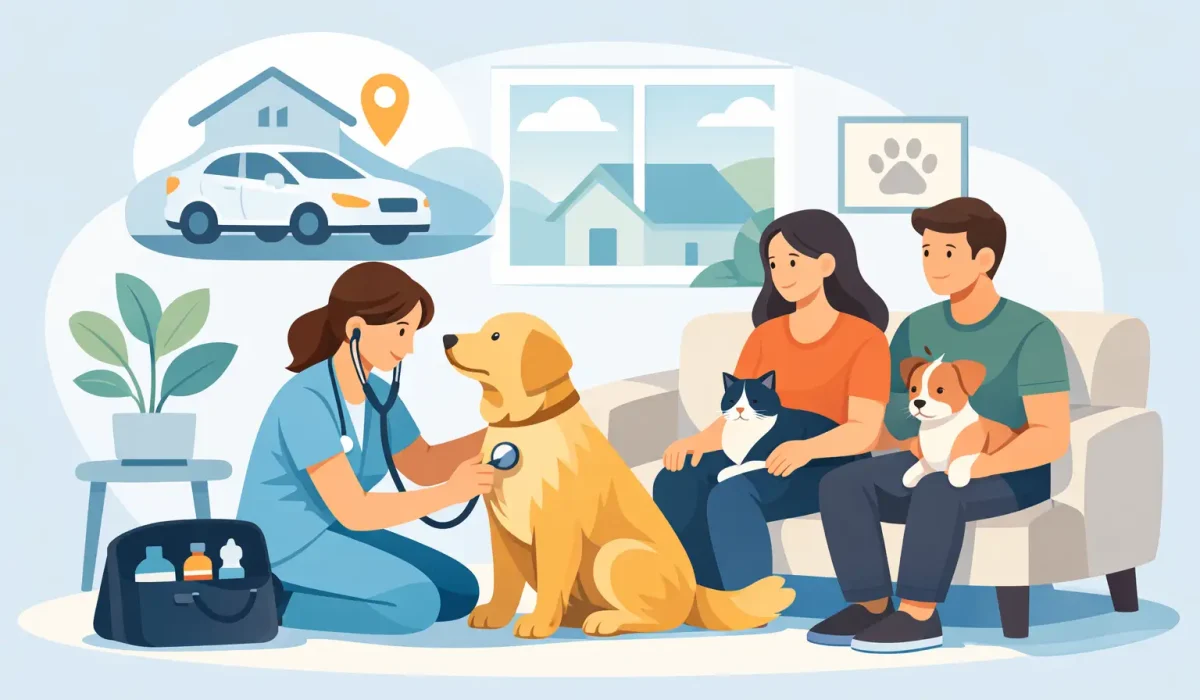
When a dog trembles just by seeing his transport box, or when a cat disappears as soon as he hears the keys, the question becomes very concrete: how does the veterinary consultation take place at home, and what should be expected on the date of the appointment? For many families, visiting home really changes the experience. The animal remains in its environment, gestures are quieter, and exchange with the veterinarian often takes on another quality.
A veterinary consultation at home is not simply about moving the practice home. The framework is different, but the medical requirement remains the same for first-line care and follow-up. This format is particularly suitable for elderly dogs, anxious cats, painful animals, those who move hard, but also for owners who want a more serene and personalized moment.
How does a veterinary consultation take place at home?
Consultation begins long before the veterinarian arrives. When making appointments, some information is generally collected: the age of the animal, its species, the reason for the consultation, its known history and its usual behaviour. This first step allows us to anticipate needs and verify that home care is adapted to the situation.
When the day comes, the arrival is voluntarily calm. The objective is not to rush the animal, but to give it a few moments to observe, feel, understand that a foreign person enters his space. In cats, this adaptation time is particularly valuable. In dogs, everything depends on temperament, age and level of anxiety.
Then comes the time of exchange with the owner. This is an essential moment, because your daily observation often brings information that an examination alone cannot give. A decrease in appetite, a change in behaviour, difficulties in getting up, a more agitated sleep or an obstacle to walking are already guiding the clinical reasoning. At home, this discussion is often more fluid, because it takes place without agitation of the waiting room or time constraints felt.
Clinical examination in animal rhythm
After this first exchange, the clinical examination begins. It is done softly, adapting to the rhythm of the animal and to what it accepts. The familiar environment often helps a lot. A cat that is frozen or aggressive in the clinic can be approached more easily on its plaid or in its living room. An arthrosic dog also better supports the examination if he did not have to get in a car and then wait on an unknown ground.
The examination covers general condition, behaviour, breathing, mobility, hydration, weight where possible, as well as the points that correspond to the reason for consultation. As needed, the veterinarian can listen to the heart and lungs, observe the gait, palpate the abdomen, examine the eyes, ears, skin or some joints.
What changes at home is not the rigorousness of the examination. It's the context. Seeing the animal evolve at home sometimes gives very useful indications. We can observe how he gets up, where he rests, if he avoids certain areas, how he interacts with you, and if his comfort is altered daily. For an elderly or painful animal, these details are very valuable.
What care can be done during the visit?
A home consultation allows for many common acts. This can include general consultation, health check-up, chronic pathology follow-up, vaccination, certain samples, blood tests or rapid tests depending on the situation. The comfort care can also be proposed, especially when the objective is to improve the quality of life of an ageing animal.
However, we must remain fair: not everything can be done at home. If heavy imaging, hospitalization, surgery or very technical emergency management is required, referral to a suitable structure may be recommended. This is where a serious approach makes the difference: the home is a precious setting, but it does not replace all the technical trays. To say this clearly is also part of a relationship of trust.
What you can prepare before the appointment
Most of the time, there is nothing complicated to organize. Above all, it is enough to create a quiet environment. For a cat, it is best to avoid unnecessary goings and comings and leave accessible the room where he feels the most safe. For a dog, a quiet place with stable soil is often ideal.
It is useful to have within hand the health book if you read, the results of previous examinations if there are, and to note upstream what you have observed. Many owners forget certain details when the time comes, especially when they are worried. Write since when the signs appeared, how often they come back and under what circumstances really helps.
If your animal is particularly fearful, it should be reported at the time of appointment. It's not a detail. This makes it possible to adapt the approach, visit time and examination conditions. At home, this anticipation is often simpler and more effective than in clinical settings, because the environment is already known to the animal.
How long does a veterinary home visit last?
The duration depends on the reason for the consultation, the number of animals seen during the appointment and the temperament of each. A simple visit for a check or vaccination will not take the same time as a in elderly animals or that an end-of-life accompaniment.
In reality, time spent is often perceived as more comfortable at home. Not because the consultation is necessarily longer, but because it is more poised. There is no return journey to be handled with a stressed animal, no waiting room, no hasty re-cage. For the owner too, this continuity greatly changes the experience of care.
In which cases is the home particularly suitable?
The home is often an excellent solution for cats who experience poor transport, elderly dogs, animals suffering from joint stiffness, those who recover less well after travel, or companions whose emotional condition deteriorates strongly in clinic.
It is also a very valuable framework for regular monitoring. When an animal has a chronic pathology, the challenge is not just to take a punctual medical look. It also aims to assess its comfort, evolution and balance found at home. In this context, the home allows a clearer understanding of the real life of the animal.
Finally, for the most sensitive moments, home accompaniment takes on a profoundly human dimension. When end of life approachingMany families want to avoid a last stressful trip. Staying in a well-known place, surrounded by familiar landmarks, often brings more calm to the animal and its relatives.
What changes for the owner
On pense d’abord au confort de l’animal, et c’est normal. Pourtant, la consultation à domicile change aussi beaucoup de choses pour le propriétaire. La parole circule mieux. Vous pouvez montrer précisément où votre chat dort désormais, comment votre chien monte difficilement une marche, ou depuis quand la gamelle reste à moitié pleine. Ce sont des éléments simples, mais très parlants.
Le sentiment de devoir aller vite est souvent moins présent. Dans un cadre familier, on pose plus facilement ses questions. On comprend mieux les priorités, les points de vigilance, et ce qu’il faudra surveiller dans les jours qui suivent. Cette clarté fait partie intégrante du soin.
Pour des familles actives, des personnes âgées, ou des propriétaires très attachés à une prise en charge douce, c’est aussi une solution pratique. Éviter le trajet, la logistique et le stress d’organisation n’a rien d’anecdotique quand on doit gérer un animal fragile.
Comment se déroule la suite après la consultation ?
Après l’examen et les actes éventuels réalisés sur place, la vétérinaire vous explique ses observations, ce qui appelle une surveillance particulière et, si nécessaire, la suite du suivi. Selon les cas, un nouveau rendez-vous peut être conseillé pour contrôler l’évolution, notamment lors d’un bilan de santé, d’un suivi de douleur chronique ou d’un accompagnement lié au grand âge.
La force du domicile, c’est cette continuité douce. La consultation n’est pas vécue comme un épisode brusque et déconnecté du quotidien. Elle s’intègre dans la vie de l’animal, avec davantage de calme, d’écoute et de précision. C’est particulièrement vrai dans une approche locale et humaine comme celle du Dr Point Elsa, où la relation de confiance fait pleinement partie de la qualité de prise en charge.
Choisir une consultation vétérinaire à domicile, ce n’est pas seulement chercher plus de confort. C’est parfois offrir à son chien ou à son chat des soins mieux tolérés, plus sereins, et mieux ajustés à sa réalité. Quand tout est fait avec douceur et attention, on voit souvent la différence dès les premières minutes.

