
A cat that hides as soon as the transport box appears, an elderly dog that struggles to get down the stairs, a painful animal that is not wanted to push further: in these situations, moving to a clinic can become a test. The benefits of a veterinarian at home for sensitive animals often begin even before the consultation: the animal remains in its landmarks, near its humans, without a journey or waiting room.
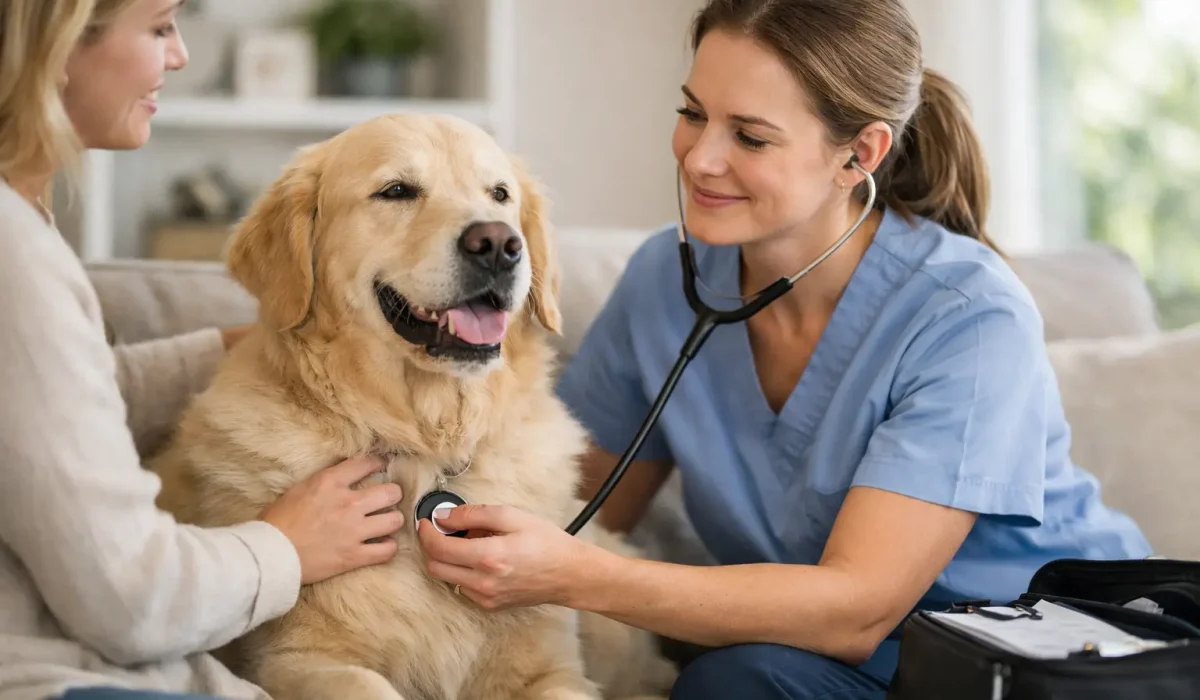
For an anxious, fragile, elderly or recovering dog or cat, this familiar setting allows to approach care with more calmness. Home consultation is not just about saving time. It also offers valuable observational conditions and a more soothing relationship for both the animal and his family.
Home veterinary benefits for sensitive animals
Reduce transport stress
For some animals, the difficulty begins long before arrival at the veterinarian. Cars, cars, traffic noises and unknown odours can cause intense fear. A cat can argue, vocalize or remain prostrate. A dog can refuse to drive or live the journey with unusual agitation.
At home, these steps disappear. The animal does not have to leave its territory and may retain some of its habits. He can stay close to his basket, sofa or trusted person. This decrease in stimulation does not mean that each consultation will be easy, but it often limits an accumulation of unnecessary tensions.
This comfort is particularly noticeable during regular appointments, such as health check-ups, vaccinations or follow-up to a pathology. When care is lived in better conditions, it becomes easier to maintain follow-up over time.
Observe the animal in its real environment
An animal does not always behave in the same way in a consultation room as at home. At home, the veterinarian can see how he/she moves in his/her home, joins his/her sleep, uses his/her bowls or interacts with the household members. These elements provide useful insight, particularly for mobility disorders, osteoarthritis, decreased form or behavioural changes.
In a cat, the location of the litter, access to a floor or the presence of other animals can also help to understand some of the difficulties of everyday life. In an elderly dog, observing a hesitant walk on the usual floor or the difficulty of getting up brings concrete information about its comfort.
This approach does not replace examinations that require clinical equipment. On the other hand, it enriches the overall assessment and makes it possible to adapt the advice to the reality of each household.
Preserving energy from fragile animals
An elderly, weakened or painful animal can find every move trying. Carrying it, getting it up in a car, waiting, and then starting the journey back sometimes takes a lot of effort. For its owner too, the organisation can become complex, especially when mobility is reduced or the animal is heavy.
Receiving the veterinarian at home avoids this additional fatigue. The meeting time is devoted to examination, listening and care, rather than to transport constraints. This is a concrete advantage for dogs suffering from arthrosis, very old cats or animals whose condition requires careful control visits.
Create a more serene exchange with the owner
At home, the pace is often less hasty. The owner can show his partner's habits, describe what worries him and ask his questions in his own environment. This discussion is fully part of the consultation: appetite, sleep, mobility, moments of discomfort or discrete changes observed over the days are all useful information.
For families very attached to their animals, being present without the pressure of a waiting room also helps to hear the recommendations better. The treatment becomes a time of exchange, with attention to the animal and those who accompany it.
Which animals benefit most from a home consultation?
The home is particularly suitable for cats who don't support the crate or unknown environments. It can also be very suitable for anxious dogs, elderly animals, those who move hard and those whose general condition requires to limit efforts.
Homes with several animals are also of interest. It is sometimes easier to organise a check-up or vaccination without having to move each one separately. For a prudent animal, the presence of his companions and markers can help to calm down, even if each temperament remains different.
However, one must keep an important shade: a known home does not always remove the fear of manipulation. Some animals remain wary of any consultation, regardless of the location. The goal is not to promise the total absence of stress, but to choose the softest and most consistent frame with their sensitivity.
How is a consultation at home going?
The visit usually begins with a time of exchange. The veterinarian collects the observations of the owner: recent evolution, behavior, feeding, mobility, history and reason for the appointment. The animal can take a few minutes to observe, feel and get used to this new presence.
The examination is then performed calmly, taking into account the animal's rhythm. As required, consultation may include a health check-up, vaccination, blood tests, rapid testing, comfort care, or assessment of pain and mobility. The veterinarian explains what he is observing and what steps to consider for further follow-up.
For the inhabitants of Cannes and neighbouring municipalities, this proximity allows for first-line care without turning the appointment into an expedition. At PointVet, Dr.Point Elsa favors this direct, careful and personalized relationship, especially valuable when the animal is sensitive or fragile.
Regular monitoring that respects the animal's rhythm
The benefits of a home veterinarian for sensitive animals are also measured over time. A one-time appointment can resolve a specific concern, but regular visits are mostly used to identify incremental changes. In an elderly animal, decreased activity, different sleep or discomfort to certain movements may occur in small touches.
Home monitoring facilitates these ongoing exchanges. The owner knows who he is and the veterinarian finds the animal in his living environment. This continuity helps to compare its condition from one visit to another and adjust comfort tips at the right time.
It is also important when the end of life is approaching. In this deeply intimate period, being able to be accompanied at home allows the animal to stay surrounded by its landmarks and relatives. Listening, delicacy and respect for the rhythm of the family then take an essential place.
When home consultation is not enough
La médecine vétérinaire à domicile est une solution très pertinente pour de nombreuses situations, mais elle a ses limites. Certains examens techniques, une chirurgie, une hospitalisation ou une prise en charge d’urgence nécessitent les moyens d’une structure équipée. Un vétérinaire à domicile peut alors orienter rapidement vers le lieu de soins le plus adapté.
Une difficulté respiratoire marquée, un malaise, une douleur brutale et intense, un saignement important ou une dégradation rapide de l’état général demandent une réaction immédiate. Dans ces circonstances, il ne faut pas attendre une visite programmée : une prise en charge urgente en structure vétérinaire est nécessaire.
Cette complémentarité est rassurante. Le domicile apporte confort, observation et proximité pour les soins adaptés, tandis que la clinique reste indispensable lorsque la situation requiert un plateau technique spécifique.
Préparer le rendez-vous sans ajouter de tension
Il n’est pas nécessaire de transformer la maison avant la visite. Préparez simplement les informations utiles : documents de santé disponibles, résultats d’examens précédents, dates des derniers soins et liste des changements observés. Si votre chat préfère se cacher, laissez-lui un accès à une pièce calme plutôt que de le poursuivre dans tout le logement.
Pour un chien, prévoyez un espace tranquille où il se sent à l’aise. Évitez de multiplier les sollicitations juste avant le rendez-vous. Une ambiance ordinaire, calme et familière est souvent ce qui l’aide le plus.
Choisir une consultation à domicile, c’est offrir à un animal sensible la possibilité d’être soigné sans être arraché à ses repères. Quand le cadre est plus doux, l’attention peut se porter sur l’essentiel : son confort, son état de santé et le lien de confiance qui vous unit.

