
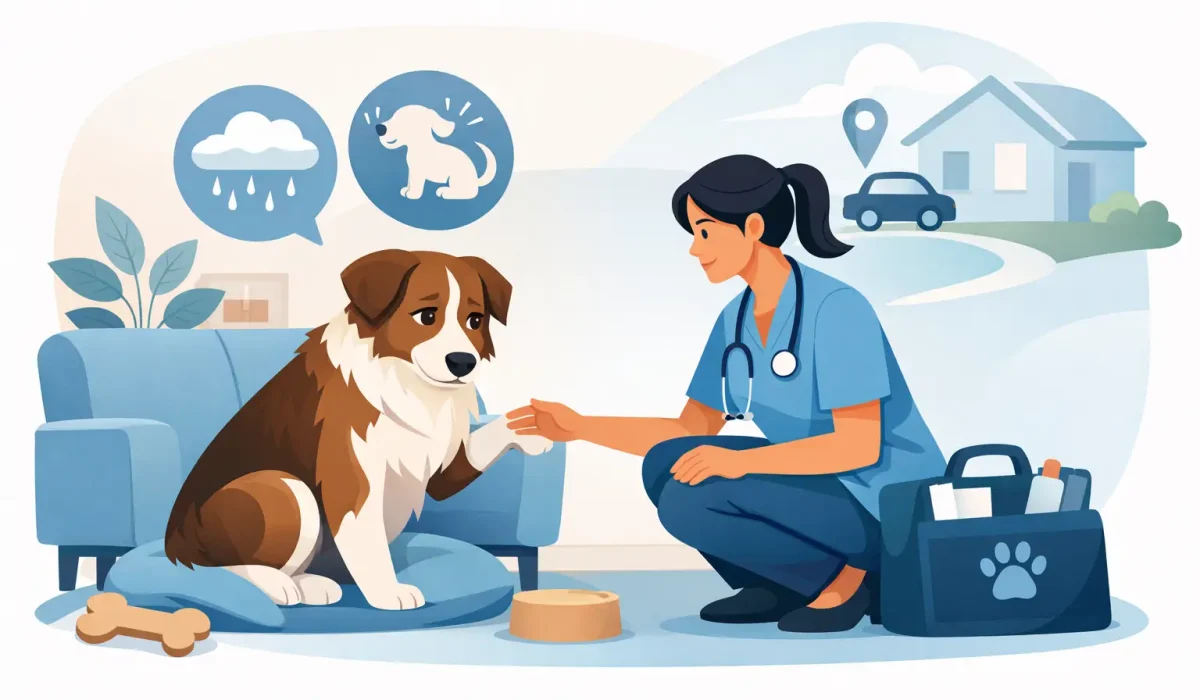
When a dog trembles as soon as he sees his leash, refuses to get in a car or hassle long before even arriving at the veterinarian, the problem is not limited to a simple one. « bad time ». For some animals, a medical examination becomes a real test. In this context, the anxiety dog solution at home takes on its full meaning, as it allows to treat in a known setting, with fewer ruptures, less noise and often much less fear.
An anxious dog is not a capricious dog. He reacts to an accumulation of signals that alert him. The journey, the waiting, the smells of other animals, the slippery floors, the manipulations in an unknown place, all this can be enough to raise the tension. In some dogs, this anxiety is visible. In others, it is more discreetly expressed by withdrawal, rigidity of the body or unusual agitation.
Why consultation is more difficult for an anxious dog
Anxiety changes the behaviour, but also the quality of the examination. A stressed dog can breathe faster, have a high heart rate, get nervous, avoid contact or become hypervigilant. These reactions do not mean that he is aggressive or impossible to treat. They show above all that its tolerance threshold is exceeded.
In a clinic, the environment imposes its own rhythm. It is necessary to arrive on time, manage the movement, wait, and then accept a series of manipulations in a space that does not belong to the animal. For a serene dog, this often remains bearable. For an elderly, sensitive, painful or very reactive dog, this can become too much.
This is where the home profoundly changes the experience. The dog keeps its bearings. It remains in its smells, its habits, its resting place. It does not have to manage the transportation stage, which is sometimes the most difficult part of the whole consultation.
Anxiety dog home consultation: in which cases is this particularly useful?
Home consultation is often very appropriate when stress begins well before treatment. This is the case for dogs who hide in sight of the harness, salivate by car, vocalize throughout the journey or arrive already emotionally exhausted.
It is also valuable to elderly dogs, which suffer less well from displacement, for those who suffer from stiffness or osteoarthritis, and for convalescent animals that it is better to house. A painful dog generally tolerates less handling and environmental changes. Reducing the stress around consultation also means avoiding unnecessary fatigue.
The home also has an interest in regular follow-up. When a dog needs a check-up, vaccination, clinical control or monitoring over time, repeated journeys can become burdensome for him and his family. In a quieter setting, the appointment is often more fluid.
Finally, there are particularly sensitive moments, such as caring for the end of life. For a fragile animal, staying at home allows him to be surrounded, quiet, without abrupt break with his daily life.
What a veterinary consultation at home actually changes
The first benefit is simple: much of the unnecessary stressors are removed. This does not mean that an anxious dog will always be perfectly relaxed at home. He may remain suspicious of an unknown person or certain gestures. But new transport-waiting-environment cumulation, which often aggravates tension, is eliminated.
The second benefit concerns observation. At home, the veterinarian also sees the animal in its living environment. Its way of moving, getting up, choosing a place to land, interacting with relatives or reacting to the approach can provide useful information. In some cases, this helps to better understand discomfort, loss of shape or behavioural change.
The third benefit is human. Owners are often more settled at home. They have their landmarks, their documents at hand, and can talk more freely about what they observe on a daily basis. This quality of exchange is very important, especially when it comes to an anxious, elderly or monitored animal for a chronic problem.
How does a home consultation for an anxious dog take place
The sweetness is not just about the place. It is also concerned with how to come to the animal, the time left to observe it and the quality of the relationship that settles. A well conducted home consultation often starts with a few minutes of adaptation. The dog can feel, look, take a distance, then come back.
The examination does not always follow a rigid order. He adapts to the dog. Some accept very well that we approach them while they stay on their carpets. Others are more comfortable near their owner. Sometimes you have to start by talking, watching, and then gradually manipulate.
This flexibility changes a lot. It helps to keep the pace of the animal more closely, without losing serious medical attention. The goal is not to be quick. It is to do well, in better emotional conditions.
Depending on the reason for consultation, it is possible to carry out numerous first-line and follow-up acts at home. This includes, for example, general consultations, health checks, certain analyses, vaccinations or assessment of chronic pain. It depends of course on the clinical situation. When a heavy technical examination or hospital care is required, the home does not replace everything. You have to say it clearly.
The limits of a home consultation
An honest approach is also to remind that home consultation is not the answer to everything. If a dog presents a serious emergency, respiratory distress, major trauma or a situation requiring a complete technical tray, an equipped structure remains indispensable.
There are also dogs for which stress is strongly linked to any human intervention, even at home. In this case, the home sometimes helps, but it is not always enough to make the examination simple. We must then adapt the strategy with a lot of tact, without promising a session « Perfect » Every time.
The fairest is therefore to consider home consultation as a particularly favourable care setting, not as a magic formula. For many anxious dogs, the difference is clear. For others, it is more progressive. In both cases, the priority remains the same: to preserve their comfort at the best while ensuring reliable medical follow-up.
How best to prepare a home appointment
A few simple gestures can help. It is best to keep the dog in a quiet room or in its usual space, without multiplying the demands just before the appointment. No need to force him to « well standing » or to stimulate it excessively. The simpler the atmosphere, the better.
Having his health book available, the list of observed changes, important dates and, if necessary, some videos taken at home can be very useful. Some of the signs appear mainly at the rise, during travel or at certain times of the day. To describe them accurately facilitates evaluation.
La présence du propriétaire rassure souvent beaucoup le chien. La voix, la posture et le calme transmis comptent réellement. Les animaux lisent très bien notre tension. Une attitude posée aide davantage qu’une succession de consignes.
Une réponse douce pour les chiens sensibles
Pour les familles qui vivent avec un chien anxieux, chaque rendez-vous vétérinaire peut devenir une source d’appréhension. On anticipe le trajet, on redoute la réaction au départ, on craint que l’animal soit épuisé ensuite. Quand les soins se font à la maison, cette charge émotionnelle baisse souvent pour tout le monde.
C’est précisément ce qui rend cette approche si précieuse. Elle ne cherche pas seulement à traiter un motif médical. Elle prend en compte l’expérience globale de l’animal et celle de ses proches. Chez PointVet, le Dr Point Elsa accompagne ce type de situation avec une attention particulière, dans une approche de proximité pensée pour les chiens fragiles, anxieux ou vieillissants.
Pour un chien sensible, être soigné là où il se sent en sécurité change souvent la qualité du moment. Et quand un soin peut être vécu avec moins de peur, c’est déjà une part importante du soin lui-même.

