

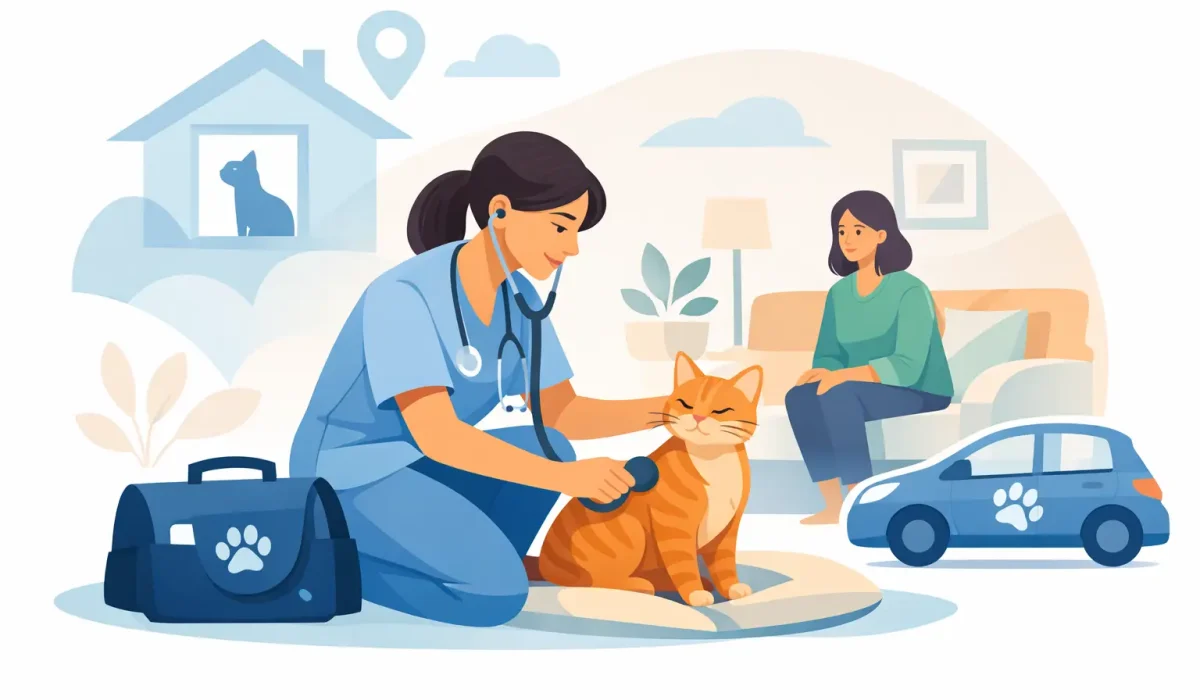
A cat that suffers doesn't always mime, doesn't necessarily limp, and can even continue to eat. This is what makes the subject of veterinary cat pain home so important for many owners. When a cat is discreet, elderly, anxious or already fragile, the simple journey to the clinic can add stress to an already delicate situation. At home, observation is often fairer, quieter, and more respectful of its rhythm.
In cats, pain rarely expresses itself dramatically. It sometimes settles slowly, with signs that can easily be attributed to age, character or a bad day. An animal that jumps less, hides more, hesitates before getting on the couch or becomes irritable is not only « less fit ». He can hurt.
Recognize a cat pain
The first change is often behavioural. A painful cat may withdraw, sleep more, avoid contact or become unusually sticky. Some stop doing their toilet with the same care. Others tolerate less than they are touched at certain places, or change their posture at rest.
Mobility also gives good clues. A cat that descends from a piece of furniture instead of jumping, who uses less of his cat tree, who climbs the stairs more slowly or who seems steep at awakening deserves special attention. In elderly cats, these signs are common in joint pain, but not only.
Appetite and bedding habits can also change. A painful cat can eat less, drink differently, or avoid a bedding box too high if it becomes painful. Sometimes the pain is also seen in the eye, in a faster breathing at rest, or in unusual fatigue.
One must keep in mind a simple reality: the visible intensity does not always reflect the intensity felt. A cat may seem calm and suffer in an important way.
Why call a veterinarian at home for a painful cat
When a cat hurts, each step counts. Taking him out of his hiding place, putting him in cash, transporting him in a car, waiting in an unknown environment with unusual smells and noises can increase his discomfort. For some animals, this is enough to raise tension, blur clinical signs or make examination more difficult.
Home consultation changes this framework. The cat stays in its environment, surrounded by familiar landmarks. It is often easier to observe it in its real movements, in its natural posture, in its relationship to its sleeping, litter or living space. This observation quality has real medical value, especially when the pain is old, fluctuating or difficult to locate.
A veterinarian at home can also better appreciate the practical constraints of everyday life. A slippery floor, an inadequate bedding, repeated steps, too high access to the rest corner or bowls can worsen an already present discomfort. These are details that sometimes go unnoticed in classical consultation but which, at home, make sense.
For owners, the benefit is also human. When you worry about your cat, not having to organize a complicated transport allows you to focus on the essential: understand what is happening and put in place a gentle care.
Veterinary cat pain at home: in which cases consult
There is no need to wait for a clear emergency to seek an opinion. Recent pain or pain that has been in place for several weeks should be evaluated, especially if it changes the cat's behaviour or comfort.
A consultation is relevant if your cat moves less, seems stiff, miaule when it is worn, hides more, changes mood, neglects its grooming or seems embarrassed to access its usual places. It is also true after a fall, a false apparent movement, or when a known pathology evolves and comfort deteriorates.
In Senior cats, vigilance must be even finer. Many grow old in silence. It is sometimes thought that they simply slow down with age, while limiting their movements to avoid pain. In this context, a home check often helps to make the difference between normal aging, joint discomfort and other causes of suffering.
There are also situations where action is needed quickly. A prostrate cat, who breathes hard, can no longer move, seems very painful at any contact or completely stops eating should be evaluated without delay. The home is suitable for many situations, but there are cases where orientation towards a technical structure remains the best option. Good care is also about choosing the safest setting depending on the state of the cat.
What a home consultation allows
The first step is based on listening. What you observe every day has great value. Since when does your cat jump less? Is it more marked in the morning? Did he change places to sleep? Is he avoiding parts? This information helps to understand the evolution, frequency and impact of pain.
Then comes the clinical examination, performed with mildness and progressivity. The objective is not only to look for a sensitive area, but to evaluate the general condition, posture, mobility, reaction to manipulation and overall comfort level. Depending on the case, some simple complementary examinations may be considered at home, such as a First-intention balance sheet or rapid tests, when they provide real aid to the decision.
The great interest of this approach is its customization. An anxious cat is not considered a very sociable cat. An elderly, painful, tired or end-of-life cat needs a particular rhythm, with measured gestures, little stress and a lot of attention to signs of saturation.
When pain falls within the duration
Not all pains are the same. There are the acute pains, which have recently appeared, and those that settle over time. In cats, chronic pain is often underestimated, especially when it affects the locomotor system.
The problem with chronic pain is that you get used to it visually. The cat adapts its movements, changes its habits and reduces certain activities. As evolution is progressive, change seems less obvious. Yet his well-being may have been altered for a long time.
At home, follow-up takes its place here. It allows to assess not only the medical state, but also how the cat lives day to day. Does he sleep better? Does it move more easily? Is he taking on some habits? Comfort is often measured in these very concrete details, those that the owner first notices.
In the region of Cannes and neighbouring communes, this type of care is particularly useful for elderly cats living in apartments, animals very sensitive to transport, or families who want a more serene accompaniment in the long term.
The role of the environment in cat comfort
Relieving a painful cat is not just a medical act. The environment counts a lot. A well-adapted home can reduce unnecessary effort and limit actions that aggravate discomfort.
Parfois, de petites modifications suffisent. Rapprocher les ressources essentielles, faciliter l’accès au repos, limiter les sauts obligés, choisir un emplacement calme et stable peuvent améliorer nettement le quotidien. Là encore, la consultation à domicile a un avantage concret : elle permet de proposer des ajustements adaptés à votre logement et à votre chat, plutôt que des conseils trop généraux.
Cette approche est particulièrement précieuse quand le chat est fragile ou en fin de vie. À ce stade, on ne cherche pas seulement à traiter un problème. On cherche à préserver une qualité de vie, de la dignité, et des moments paisibles à la maison.
Douleur chat vétérinaire domicile : une approche plus douce
Choisir une consultation pour douleur chat vétérinaire domicile, ce n’est pas choisir la facilité au détriment de la qualité. C’est souvent l’inverse. Pour certains chats, être vus chez eux permet une évaluation plus fidèle, plus fine, et une prise en charge plus sereine.
Cela ne veut pas dire que le domicile remplace tout. Certaines situations nécessitent une hospitalisation, une imagerie ou des soins techniques réalisés en structure. Mais dans de nombreux cas de douleur, d’arthrose, de suivi de pathologie ou d’accompagnement d’un chat âgé, le domicile offre un cadre particulièrement adapté.
Le Dr Point Elsa accompagne justement ces moments avec cette attention calme, précise et humaine qui change beaucoup de choses quand un animal n’est pas bien. Pour le chat, le soin se fait sans rupture brutale avec son univers. Pour le propriétaire, il y a souvent plus de clarté, moins de stress, et la sensation d’être réellement accompagné.
Si votre chat vous semble moins souple, moins présent, plus irritable ou simplement différent, faites confiance à ce que vous observez. Chez eux, les signes sont parfois discrets, mais ils méritent d’être entendus tôt. C’est souvent ainsi que l’on protège le mieux leur confort, avec douceur et sans attendre qu’ils souffrent davantage.

