

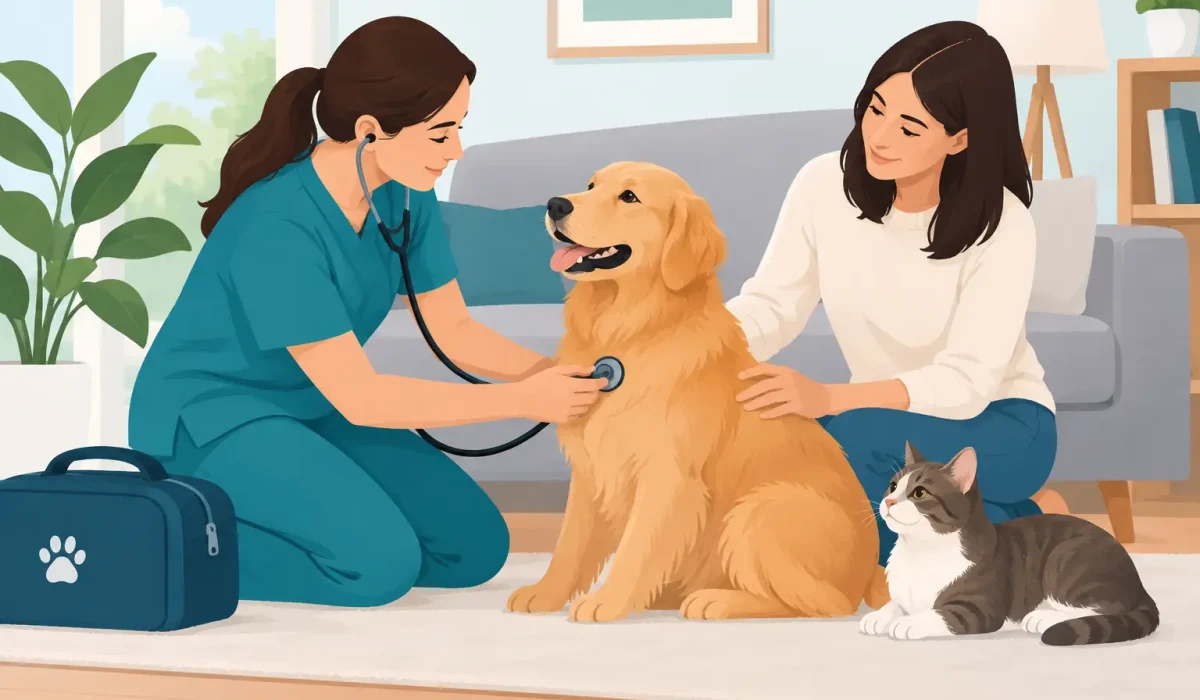
A cat hiding as soon as the transport box appears. An elderly dog who struggles to get in a car. A family that wishes to preserve the peace of its companion in a delicate moment. These are precisely the best situations for a veterinarian at home: those where the care can be carried out seriously, while avoiding a displacement that causes fatigue, pain or anxiety.
Receiving a veterinarian at home does not mean giving up medical quality. This is another way of organising the consultation, in a framework that the dog or cat already knows, with more time to observe, listen and explain. For many common and ongoing care, this approach brings concrete comfort to both the animal and its owner.
Best situations for a veterinarian at home
Home consultation is particularly relevant when travelling to a clinic may increase the stress of the animal or complicate its management. It also meets the needs of the owners for whom to move their companion has become difficult, without delaying the necessary care.
The home allows the veterinarian to appreciate the animal in its environment: its appearance when it moves home, its installation, its usual behavior with its relatives. These elements are not a substitute for a clinical examination, but they can usefully inform consultation.
An anxious animal in the face of transport
Some cats associate the transport box with an unpleasant experience. They hide, voice, become difficult to manipulate or remain very tense long after the return. Also in the dog, the car, the waiting room, the smells and unusual noises can cause serious concern.
At home, the animal remains on its territory. It can take a few minutes to observe the veterinarian, stay close to his basket or get reassured by his owner. The examination is of course adapted to his temperament, with calm gestures and as smooth handling as possible. This approach does not remove any apprehension, but often avoids the accumulation of travel stress and waiting.
An elderly, painful or unmovable dog or cat
With age, a once simple move can become stressful. Wearing a cat to the car, helping a big dog get up there, making it wait on slippery ground or in an unknown space sometimes takes a lot of effort. For animals suffering from stiffness, osteoarthritis or reduced mobility, each step can be uncomfortable.
The home visit allows you to perform a health check, a pain check, an assessment of mobility or comfort care without imposing this logistics. The veterinarian can also see how the animal gets up, travels in its housing and accesses its places of rest. Simple details, observed in everyday life, help to better understand the difficulties encountered.
Regular monitoring that deserves to be kept simple
Prevention and control appointments do not have to become a test. Vaccinations, health checks, blood tests, rapid tests and followed by pathologies can, depending on the situation, be organised at home. This solution is particularly suitable for households with more than one animal, for people with a busy schedule or for those with difficulties in moving.
The main benefit is often regularity. When it is easier to make an appointment, it becomes easier not to delay a recommended check or to have a change in behaviour, appetite or general form assessed. A follow-up carried out in good conditions allows us to act with more serenity.
When several animals live at home
Bringing several dogs or cats in consultation requires a real organization. It is necessary to prepare the boxes, manage the journeys, limit tensions between the animals and sometimes plan several trips. At home, everyone can be examined in a familiar place, with an organization adapted to the rhythm of the home.
This situation is particularly comfortable for cats who live together but do not all react in the same way to handling. One can remain curious, the other prefers to observe at a distance. Consultation can respect these differences without hastening things.
A precious presence at the end of life
The end of an animal's life is an intimate moment, often filled with emotion and questions. When a companion is very weak, painful or almost no longer moving, the home offers a more peaceful setting for accompaniment. The animal remains surrounded by its landmarks, its smells and people he loves.
The consultation provides an overview of its comfort, general condition and possibilities of accompaniment. Where Home euthanasia is envisaged, it can take place in the soft, without difficult journey or waiting room. The owner has the time to ask questions, be present and say goodbye to his animal in the privacy of the home.
There is no easy decision at these times. However, being accompanied by a listening veterinarian helps to advance step by step, with respect for the animal and for the relationship that unites you.
What home consultation actually allows
A mobile veterinarian can carry out numerous first-line and follow-up actions: general consultation, clinical examination, vaccination, health check-up, blood sampling, rapid tests, follow-up of a known pathology, assessment of osteoarthritis or pain, as well as comfort care.
The visit usually starts with an exchange. How long have you been watching this change? Does the animal eat as usual? Is he sleeping more? Is he moving differently? This information, together with the review, is used to determine the course of action and to clearly explain the next steps.
With PointVet, Dr.Point Elsa offers home care for dogs and cats in the Cannes area and nearby municipalities. The direct relationship with the veterinarian allows for personalized follow-up, especially when the animal is fragile or the situation changes over time.
When a clinic remains the most suitable solution
Home is not the answer to all situations. Respiratory distress, accident, severe bleeding, suspicion of poisoning, convulsions, severe acute pain or a rapidly deteriorating general condition require urgent management in an equipped structure. Similarly, some imaging, surgical and hospital examinations require the equipment and team of a clinic.
Choosing a home visit, therefore, is also about recognizing its limitations. A local veterinarian can assess a situation, direct to the appropriate structure when necessary and help you not to remain alone in the face of concern. The right choice always depends on the state of the animal, the degree of urgency and the care it needs.
How to prepare the appointment without adding stress
Il n’est pas nécessaire de transformer votre maison en salle de soins. Préparez simplement un espace calme, suffisamment éclairé, où votre animal se sent habituellement en sécurité. Pour un chat, il peut être utile de fermer les accès aux cachettes très difficiles à atteindre avant l’arrivée de la vétérinaire, sans le poursuivre ni le brusquer.
Gardez à portée de main son carnet de santé, les résultats d’examens précédents si vous en avez, ainsi que vos observations récentes. Une courte note sur les changements constatés peut être très utile : fréquence, durée, circonstances, évolution. Si votre animal a une démarche inhabituelle ou un comportement intermittent, une vidéo prise chez vous peut aussi aider à montrer ce qui ne se produit pas forcément pendant la consultation.
Enfin, restez simplement auprès de lui avec votre calme habituel. Votre présence est souvent son meilleur repère. Une main posée doucement, une voix familière et un rythme sans précipitation créent les conditions les plus rassurantes possibles pour recevoir les soins.
Lorsqu’un rendez-vous évite à votre compagnon une épreuve inutile tout en lui apportant une attention médicale sérieuse, le domicile devient bien plus qu’une solution pratique : il devient un lieu de soin, de confiance et de douceur.

