

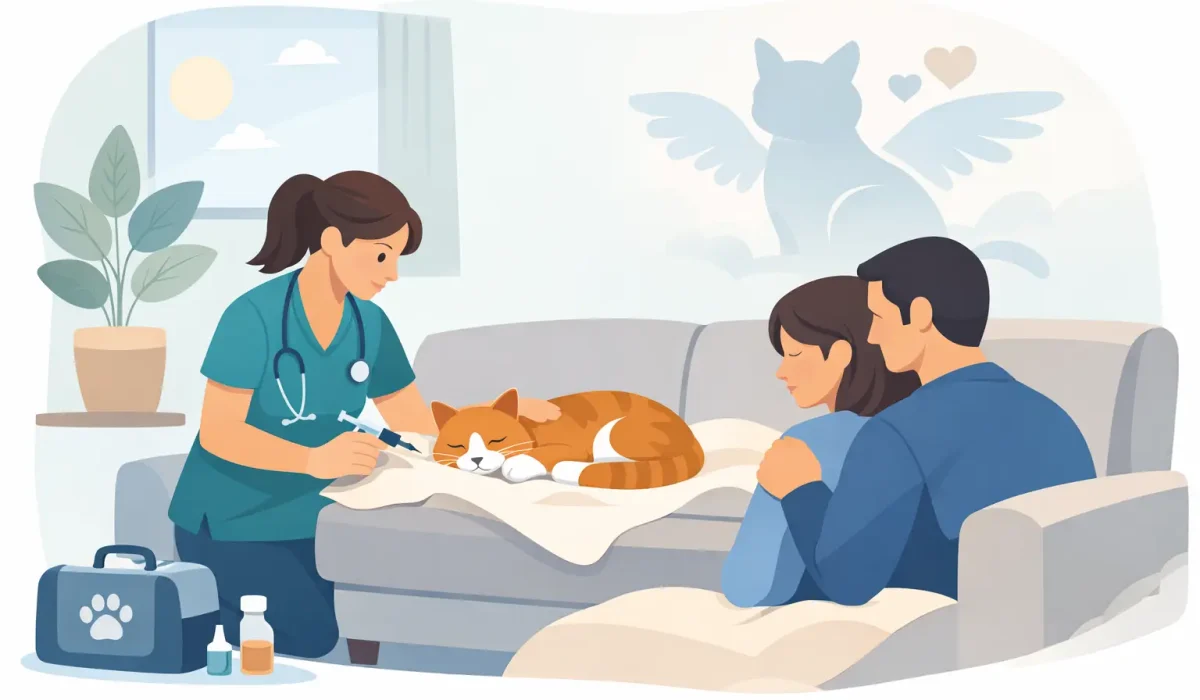
When a cat declines, the owners often feel it before even getting to put precise words on the situation. He eats less, isolate, seems tired, or on the contrary finds no more comfortable position. In those moments, the question of cat euthanasia at home may appear as a softer, more calmer possibility, and more respectful of what the animal is experiencing.
Choosing this framework does not remove the pain of the decision. On the other hand, this can avoid additional stress related to transport, waiting room, unknown odours and breakage of markers. For many elderly cats, anxious or very weakened, staying at home really changes the experience of the last moments.
Why choose a euthanasia cat at home
A cat who is sick or at the end of life often suffers from travel. Even a short journey can be difficult if the animal is painful, disoriented or breathless. At home, he stays in his basket, on a sofa, in a familiar corner or in the arms of his owner if that's what reassures him most.
This setting also allows the family to live this moment with more privacy. There is no precipitation, no external noise, no sensation of having to contain his emotion. Time is spent on animals, with attention paid to both care and human accompaniment.
This does not mean that home is always the only right option. Some medical situations require another organization, especially if the animal's condition changes very abruptly. But when accompaniment can be anticipated, the house often offers more serene conditions.
How to know if the time has come
This is the most difficult question, and there is no mechanical answer. The decision is based not on a single sign, but on a set of elements observed over the days. We look at the cat's ability to eat, drink, move, rest, interact, groom and maintain a minimum of comfort.
Some cats continue to seek the presence of their relatives despite the disease. Others gradually close, stay prostrate, seem permanently embarrassed or no longer enjoy anything. What counts is not only the remaining lifespan, but the actual quality of life.
We must also accept that a cat can compensate for a long time. He may seem to hold, while he is in suffering or very diminished. Conversely, a very old animal can have bad days and then get a little calm. This is why an exchange with a veterinary is essential. The goal is not to decide in your place, but to help you see the situation fairly and without unnecessary guilt.
How is euthanasia at home?
The process is designed to be calm, progressive and respectful. First of all, the veterinarian takes time to exchange with you. This moment allows you to confirm the decision, answer the last questions and adapt to your cat, his condition and your way of living this passage.
The animal is installed in the place that suits it best. He may be on a blanket, in his usual bed, or near you. The veterinarian acts gently and carefully, ensuring that any source of discomfort is minimized. The pace is important. We don't rush the cat or the family.
In most cases, owners fear that their animal will feel fear or pain. It's a normal concern. The goal of euthanasia at home is precisely to offer a peaceful end of life, in a known setting, with a careful veterinary presence at each stage.
You can usually choose to be present all along, or only at the beginning if it seems too difficult. There is no universal good way to live this moment. Some people need to hold their cat to the end. Others prefer to talk to him and then retire for a few moments. What matters is to respect your relationship with him, without imposing an image that doesn't match you.
Should children or other animals be present
Again, it depends on each home. For children, attendance can be helpful if it is prepared with simple, true and age-appropriate words. Keeping them away by protective reflex is not always the softest solution. But neither should they be forced to attend something they do not want to see.
For other animals in the house, the question is more subtle. Some dogs or cats are indifferent. Others clearly perceive that something is happening. Allowing them to be nearby, without forcing them, can sometimes help maintain a familiar setting. Again, the veterinarian can guide you according to the pattern of the home.
What it is useful to prepare before the visit
There is no need for much, but some simple preparations make the moment more peaceful. Choose a quiet place, with enough space for the veterinarian to intervene comfortably. Prepare a blanket, your cat's favorite bed, or anything familiar to her.
You can also think in advance about what you want after death. In these moments, it is often difficult to make a decision quickly. Having addressed this issue upstream avoids an additional emotional burden. If you need to talk about it before the visit, it is best to do so without waiting for the last moment.
If your cat has very marked habits, say so. Some like to be wrapped, others hate to be moved. Some are quieter on the ground, others in arms. These details matter. They are part of the accompaniment.
The role of the veterinarian in such a sensitive moment
In euthanasia at home, technical competence is indispensable, but it is not enough. It also requires a calm presence, listening, clarity and a real ability to adapt to family emotion. You don't need a complicated speech. You need to understand what is happening, to be accompanied without pressure and to feel that your cat is considered with dignity.
This is particularly true when the decision has been long to mature. Many owners wonder if they are acting too soon, or too late. A veterinarian experienced in end-of-life accompaniment can accommodate this doubt. He's not sweeping it. It lights up.
At home, this relationship often takes on a different dimension. The care enters your living space, with more proximity and less formal distance. For families of Cannes and neighbouring municipalities who wish to avoid their cat a last difficult journey, this accompaniment can make a real difference.
After euthanasia, what do you really feel
There is no single normal reaction. Some owners cry immediately. Others remain very calm at the moment, then collapse later. Some feel relief because the suffering of the animal is over, then feel guilty because of this relief. All this can coexist.
The penalty for the loss of a cat is often profound, even though it is sometimes minimized by entourage. Yet the relationship with an animal structures the daily life, the habits, the simple gestures of the house. His absence leaves a very concrete void.
Il faut se laisser du temps. Ranger trop vite ses affaires peut être difficile, mais tout garder intact peut l’être aussi. Il n’y a pas de règle. L’essentiel est de respecter votre rythme. Si vous vivez seul, ou si ce deuil est particulièrement lourd, parler avec un professionnel de confiance peut aussi aider.
Une décision d’amour, même quand elle fait mal
Demander une euthanasie chat à domicile n’est pas renoncer à son animal. C’est parfois choisir de ne pas prolonger une souffrance quand il n’y a plus de confort possible. Cette décision demande du courage, parce qu’elle oblige à penser d’abord au bien-être du chat, même quand cela brise le cœur.
Chez PointVet, cet accompagnement est pensé avec douceur, précision et respect du lien qui vous unit à votre compagnon. Dans ces heures si particulières, le plus précieux est souvent simple : un lieu familier, une présence calme, et la certitude que votre chat est entouré jusqu’au bout.

