

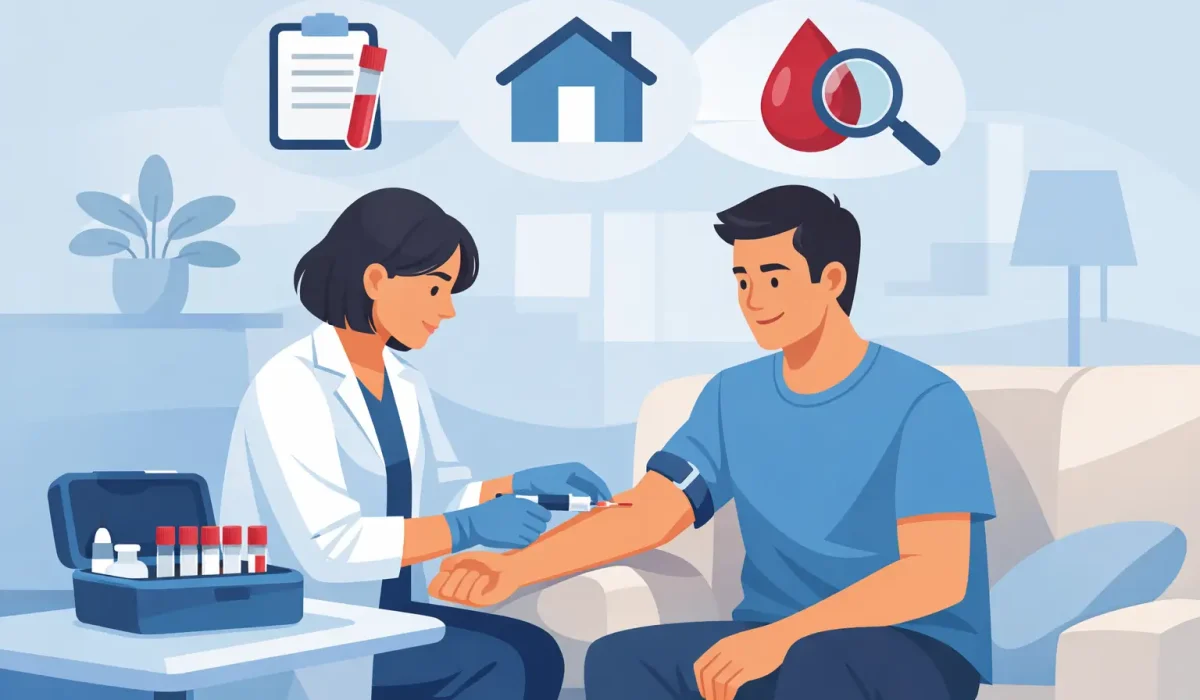
A cat that hides as soon as the transport box appears, an elderly dog that struggles to get in the car, or simply a busy day: the reasons to ask « can we do home blood check » many. For a dog or cat, the answer is often yes. Blood can be taken from you by a veterinarian, in a calm and familiar setting, when the condition of the animal and the type of analysis permit.
This treatment is not limited to sampling. It is part of a careful consultation, with a clinical examination, an exchange on the changes observed at home and an interpretation of the results adapted to your companion.
Can we do a home blood check for his animal?
Yes, a home blood check is quite possible for many common situations. The veterinarian moves with the necessary equipment to carry out the sampling in good health and safety conditions. Based on the analyses requested, some results can be obtained quickly through on-site testing. Further samples are prepared and then forwarded to a veterinary laboratory.
The home offers a concrete advantage: the animal remains in its landmarks. It does not have to undergo the journey, waiting in an unknown room, the smells of other animals or the sometimes impressive noises of a care structure. This difference is particularly important for sensitive cats, anxious dogs, painful animals and elderly companions.
However, the home blood test is not suitable for all circumstances. If your animal suffers from severe distress, malaise, difficulty breathing, heavy bleeding or a rapidly deteriorating condition, clinical management may be required. The goal is always to choose the safest and most suitable place for its condition.
In what cases is a blood test useful?
A blood test provides valuable information that is not always visible during the examination. It can help to evaluate the functioning of certain organs, to look for a cause of unusual fatigue or to follow the evolution of an already known pathology.
In an animal that grows older, a regular health check can sometimes identify a silent change early. Your dog eats less, drink more, seem less enthusiastic on walks or sleep longer? Your cat loses weight, changes its bedding habits, isolates or becomes less careful? These changes deserve consultation, even if they seem discreet.
Sampling may also be proposed as a follow-up. The results are then compared to previous reviews, which helps to observe a change over time rather than relying on a single isolated value. This is particularly useful when the animal is fragile and repeated movements become difficult.
A review does not replace clinical examination
Blood provides guidance, but it never tells the whole story alone. Your animal's behaviour, appetite, weight, daily comfort, heart, breathing or palpation during the consultation count as well.
That's why the veterinarian starts by listening to you and examining your companion. A slightly modified value does not have the same meaning depending on its age, history and observed signs. Conversely, results in standards do not always prevent further research if warranted by clinical examination.
How's a blood sample going at home?
The appointment begins with an exchange time. Prepare, if possible, useful information: date of onset of symptoms, evolution of appetite, weight, thirst, stool or urine, results of previous analyses and recent habits of your animal. These elements allow the most relevant examinations to be determined without unnecessarily multiplying the sampling.
The blood sample itself is usually fast. The sampling area shall be chosen according to the animal and the necessary volume. Your presence can be reassuring, provided you remain calm. Some dogs prefer to be near their owner; Some cats are more serene when they remain discreetly wrapped in a towel or installed in their favourite corner.
Even at home, not all animals react in the same way. An anxious companion can move, tender or seek to get away. Gentleness, patience and adaptation to the animal's rhythm are essential. Sometimes it may be better to take a few more minutes to let him calm down rather than rush the gesture.
After sampling, a slight pressure is exerted on the area to limit the appearance of a small blue. Your dog or cat can then resume a quiet activity. Simple monitoring is enough: avoid handling the area if it appears sensitive and report any unusual reactions to the veterinarian.
Should we leave her dog or cat fasting?
This depends on the analyses planned. For some balance sheets, fasting improves the reliability of interpretation, as a recent meal may change certain values. In this case, the order is usually to remove the food for several hours before the appointment, while leaving the water available.
But it is not necessary to impose fasting on one's own initiative, especially in a very young, fragile, diabetic animal or whose general condition is concerned. The duration and modalities must be specified at the time of appointment. If your animal has eaten, simply say: the information will make it possible to adapt the analysis or its interpretation.
For cats, fasting requires a particular organization. A game forgotten in another room, an access to the outside or a meal given by a relative can distort the preparation. It's better to anticipate without making a mistake if something happens.
What results can be expected, and within what time frame?
Some reviews provide initial guidance during the consultation. When the sample is sent to the laboratory, the deadlines vary according to the analyses requested. The veterinarian will then tell you the expected sequence and contact you to explain the results clearly.
Receiving an encrypted report may be a source of concern. However, an anomaly does not automatically mean that a situation is serious. It may be transient, context-related, or require control before any conclusion is reached. Conversely, a normal result is useful information, but always close to the real state of the animal.
The essential thing is to be able to ask your questions: what exactly is measured? What value deserves special attention? Should we monitor a change at home, schedule a check or consider further examinations? An explanation is often used to turn a hard-to-read result sheet into concrete decisions for the comfort of your companion.
The limits of a home blood test
Home medicine is particularly suitable for first-line consultationsfollow-ups and animals for which transport is a source of stress. Nevertheless, it has limits. Some situations require hospital equipment, imaging, continuous monitoring or immediate intervention that cannot be replaced by displacement.
There are also practical constraints. Sampling may be more sensitive in a highly agitated, dehydrated or veined animal. In this case, the veterinarian evaluates the best solution with you, without forcing a care that would unnecessarily put your animal in trouble.
In the area of Cannes and neighbouring communes, a home consultation with Dr Point Elsa allows this type of follow-up to be carried out in a soothing environment, when the situation lends itself to it. The benefit is not only practical: it often helps the animal to live the care with less tension, and its owner to remain fully present.
When to ask for advice quickly?
A blood check can be organized calmly when it comes to control or moderate signs. However, do not hesitate to ask for advice if your animal no longer eats, vomits repeatedly, seems to be very shot down, breathes hard, no longer manages to get up, has very pale mucous membranes or shows marked pain. These signs require rapid assessment to determine the most appropriate mode of support.
Observing your pet on a daily basis remains your most valuable role. You know his usual approach, his look, his rituals and his little changes in behavior. When something seems different, even without apparent urgency, talking about it early often allows you to move forward with more serenity.

